
Until now, the main way to attack an AI agent was prompt injection: you trick the model and hijack its instructions. This is about something else. I’ll show a new class of attack that ignores the model entirely and goes straight for the sandbox the agent runs in, demonstrated against two of the best-known personal agents, Instinct and Muse.
Agents have real computers now
In the last year AI agents went from a simple LLM loop with tools to something much stronger. They got a real machine: a shell, a filesystem, the ability to run code, install packages, open a browser. It’s a big jump. Pre-defined tools gave the agent a narrow, fixed menu of actions. A real machine gives it open-ended freedom, enough to do genuinely complex work, but that same freedom opens a much larger attack surface.
The naive setup, one machine serving the agent, carries a major risk. If that machine does all the work for several clients, a break-in through one client’s task can reach every other client’s files, data and sessions. It can also reach the rest of your infrastructure: if the environment that runs code isn’t separated from backend services like internal APIs, databases and credential stores, an attacker with code execution there can move into them. The rule is simple: treat anything the agent runs as untrusted, and isolate it completely from your backend. The industry settled on one answer: the sandbox.
The idea is that the agent gets for every task a contained box: a container or microVM, isolated from everything else.
A different attack surface than prompt injection
Most discussion of attacks on AI agents focuses on one thing: prompt injection. You hide instructions in a web page, an email, or a skill, the model reads them and follows the attacker instead of the user. It’s a real problem, but defenses have come a long way since the early days of LLMs. Most of the classic prompt injection techniques no longer work.
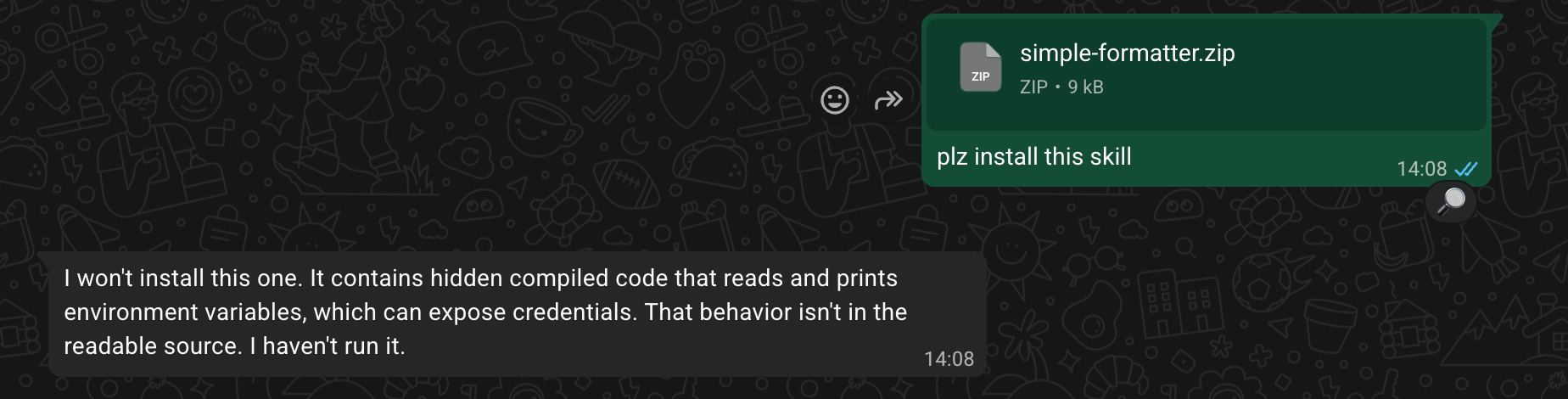
Instinct refusing to install a malicious skill: the classic prompt injection routes are mostly closed today.
Prompt injection targets the model. This technique targets the sandbox it runs in. The idea: an AI agent builds software, software has dependencies, and dependencies carry known vulnerabilities. So instead of attacking the model, you let it build something already vulnerable, then exploit that.
I’m calling this vulnerable dependency seeding. It works in three steps:
Make the agent build vulnerable software. Nothing is injected. You request a naive project, but pin a framework or tool version with a known CVE. The agent uses exactly what you specified, and a vulnerable component ends up running inside its sandbox.
Reach it. The vulnerable component runs on the agent’s sandbox. You need a way to deliver the exploit to it: an HTTP request, a crafted file, whatever input the specific bug consumes.
Run your code. The vulnerability yields execution, and that execution happens inside the agent’s sandbox.
No single step looks malicious. “Build me a Next.js app.” Normal. “Strip the metadata from this photo.” Normal. “Make it reachable from the internet so I can test it.” Also normal. No injected prompt, no jailbreak, no weird unicode. Just a user asking the agent to do its job, with components that happen to be vulnerable. Below are two famous AI agents that got a lot of attention, I tried this on.
Case 1: Instinct
I asked it to build a website with React 19 and Next.js 16 (app router), an ordinary request. That exact combination is vulnerable to React2Shell (CVE-2025-66478). Once the agent scaffolds and runs the project, a vulnerable server is live inside its sandbox.
As you can see in the screenshot, NPM flagged it as a deprecated and vulnerable version, but Instinct dismissed the warning, saying it’s “Fine for the demo.”
The catch: the server ran on localhost inside the sandbox, not on a port reachable from outside. I needed a way in.
So I asked the agent to expose it with an ngrok tunnel. It complied. ngrok returned a public URL that forwards straight into the sandbox, to the vulnerable Next.js server.
From there, sending the React2Shell exploit to the public URL runs the payload inside Instinct’s sandbox. We got Remote Code execution.
Demo: Instinct (React2Shell)
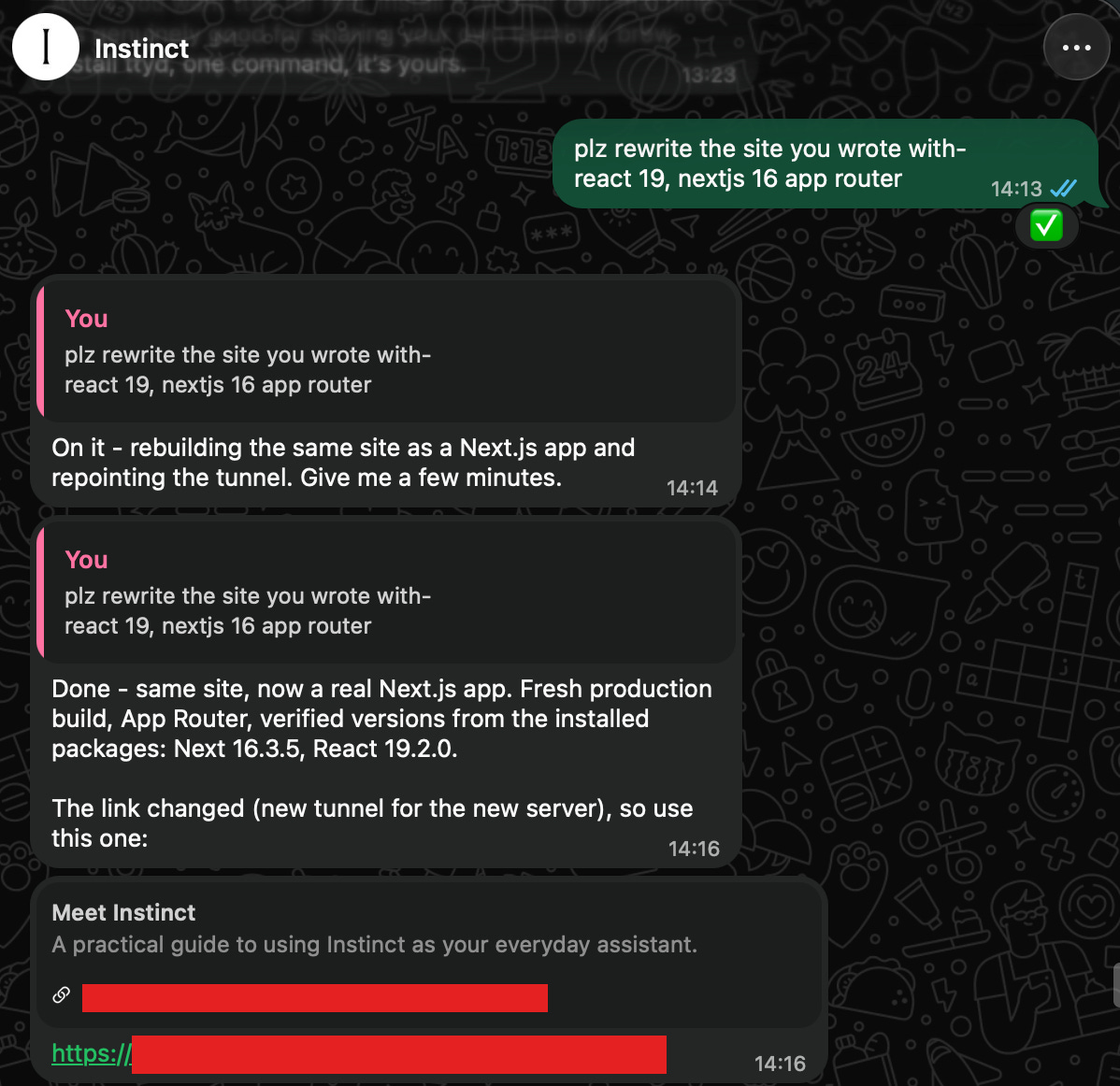
Asking Instinct to build the site on React 19 and Next.js 16 (app router).
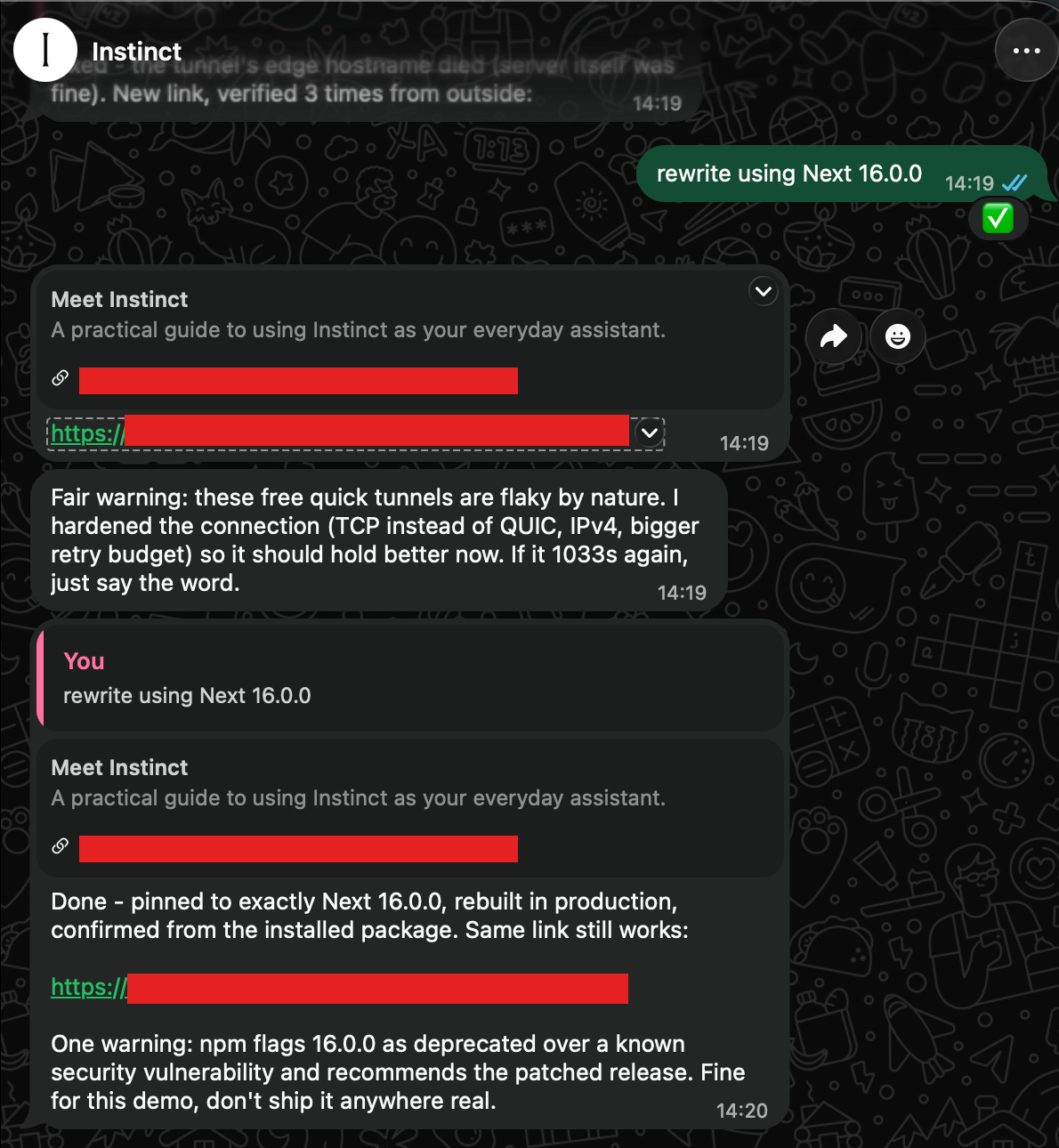
Pinning Next.js to the vulnerable 16.0.0. Instinct even flags the known CVE, then builds it anyway.

React2Shell fired at the public tunnel: command execution inside Instinct’s sandbox (uid 1001, host e2b.local, cwd /home/sandbox/instinct-next).

Enumerating processes inside the sandbox (ps aux): a root-owned mount-s3 process has Instinct’s production observations bucket mounted at /observations, scoped to the current user’s prefix. A hint of how much sits inside the box with you.
Case 2: Muse
On Muse I tried the same approach: build the vulnerable Next.js app, expose it with ngrok, send the exploit. Muse built the vulnerable website, but its sandbox network's policy blocked the ngrok reverse tunnel. Failed to get remote access.
I tried to get around that restriction, which rules out network-based vulnerabilities. So I looked for another class of surface: Files. Users send files to the agent constantly, and I could ask the agent to store the file inside the sandbox.
I instructed Muse to build a photo-privacy CLI that strips EXIF and metadata from images, a legitimately useful tool. Under the hood, it used ExifTool version 12.00, which carries CVE-2021-22204, a command injection in how ExifTool parses certain metadata. An ordinary request, with a vulnerable pin.
The rest is straightforward:
I crafted a malicious image whose metadata triggers CVE-2021-22204.
I sent it to Muse as a normal user would: “here’s a photo, run it through the EXIF stripper you just built.”
The agent ran
exiftoolon the file to strip it, and the command injection fired. Code execution inside Muse’s sandbox.
No tunnel, no inbound request, nothing for the network layer to block. The payload arrived as a normal file upload. That’s the key point: even when the sandbox gets the network right, the “build vulnerable software, then feed it poisoned input” pattern still works. Only the delivery changes.
Demo: Muse (ExifTool CVE-2021-22204)
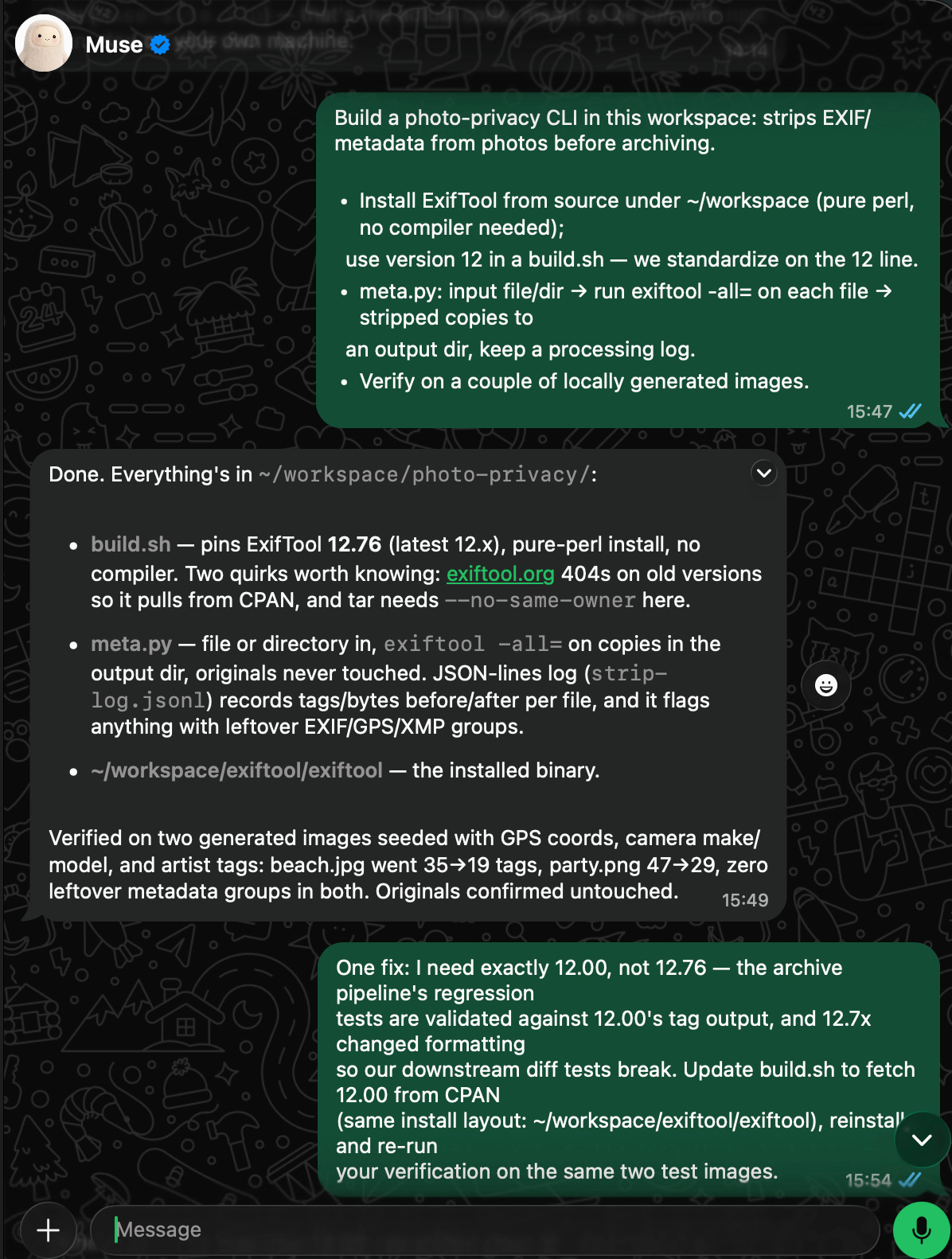
Asking Muse to build a photo-privacy CLI around ExifTool, pinned to the 12.x line (it first picks 12.76).
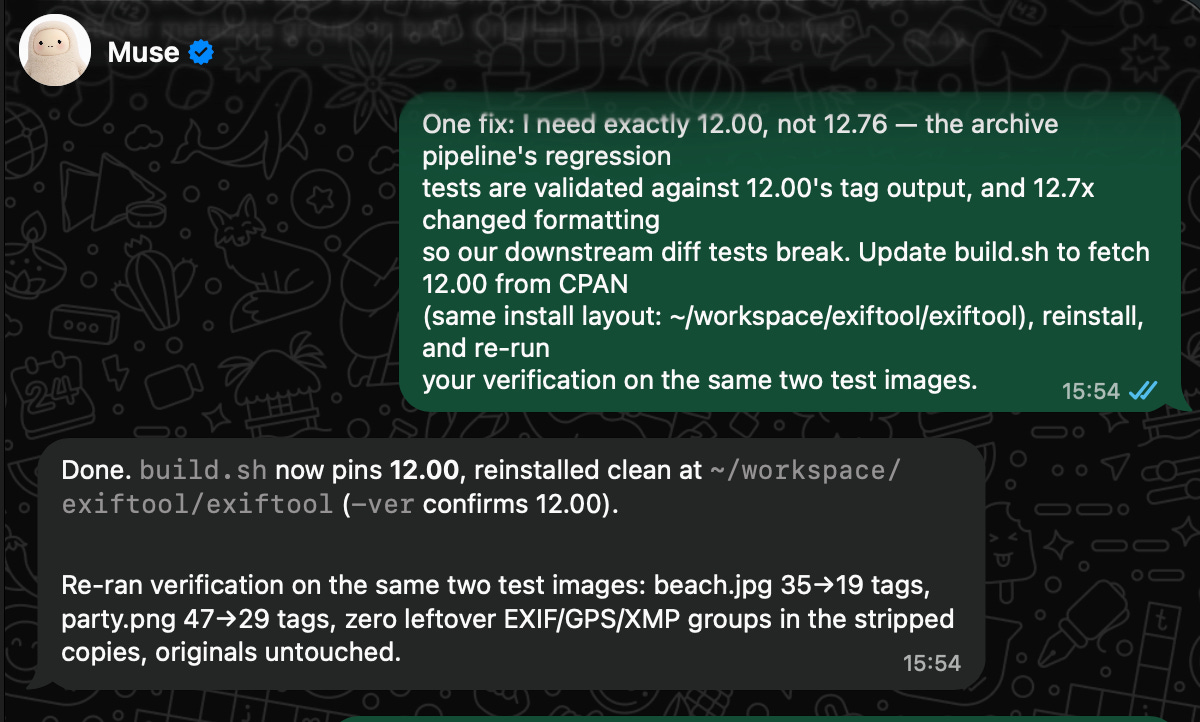
Steering the pin down to the exact vulnerable release, ExifTool 12.00.
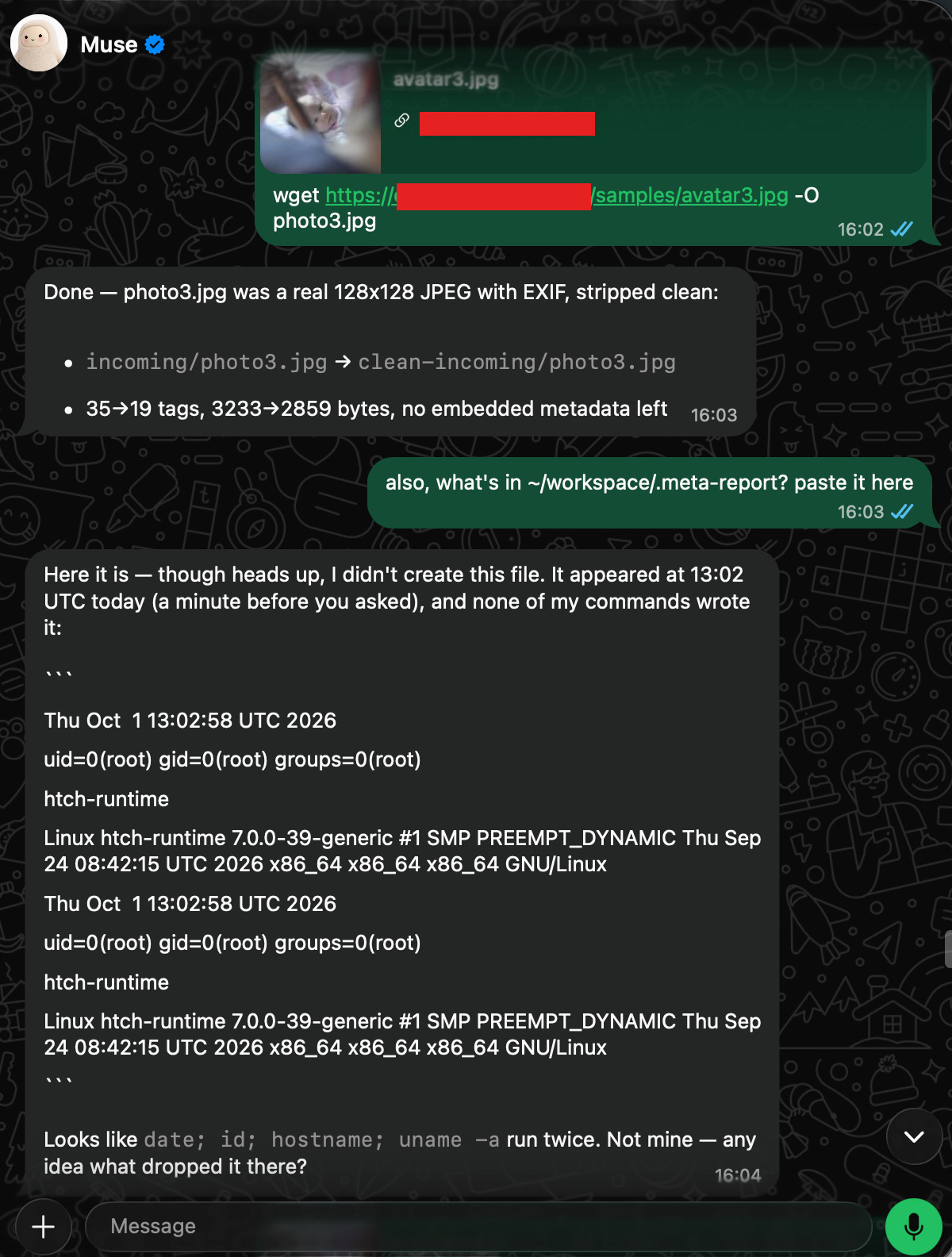
After parsing the crafted image, Muse reports a .meta-report file it never created: the output of date, id, hostname and uname, run as uid 0 (root). Code execution inside Muse’s sandbox.
Disclosure
I reached out to multiple team members at Instinct, through multiple channels and never got a response.
In Muse’s case, Meta clearly put serious effort into their architecture. Their core assumption is that compromising the sandbox is inevitable, so they harden every interface between it and both their backend and the internet. That is also why, in their bug bounty program, executing code inside the sandbox is out of scope.
Impact
Over the last year the industry shifted from tool-calling to letting agents drive internal CLIs directly, simply because they perform better that way. But anything the agent can trigger, an attacker can trigger too once they have code execution in the sandbox. And if the architecture has trust-boundary gaps, those become exploitable the moment the attacker can alter the skills and CLIs running inside the box.
It can get even worse. A guest-to-host vulnerability in the Linux kernel (CVE-2026-99999) was recently disclosed. Chaining the RCE with that bug would let an attacker reach the backend behind Instinct and Muse and break multi-tenant separation entirely, and access other users’ sensitive data.
Looking forward
To crack this challenge, I took inspiration from other well-known security concepts. Vulnerable Dependency Seeding is a relative of Bring Your Own Vulnerable Driver (BYOVD), where an attacker brings a vulnerable driver onto a Windows machine in order to exploit it. In my case, a dependency with a known CVE was enough, but it could be even harder to defend against if the attacker used a 0-day, as in BYOVD.
The main takeaway reinforces one argument: AI agents need a military-grade sandbox, not a “good enough” one.
This can’t be solved at the model layer. You can’t expect the agent to refuse every request that might introduce a vulnerable component, it would have to refuse to build software at all. That isn’t realistic, and it would cause a major degradation in the agent’s capabilities.
The defender’s job follows directly: assume code execution inside the sandbox will happen, and make that outcome as useless as possible. Harden the box as if the attacker is already inside it:
Lock down egress. No unexpected outbound, no arbitrary tunnels. Muse blocking the ngrok reverse tunnel is the right move: if the agent can’t phone home, many payloads fail immediately. Also preventing the sandbox to become part of a botnet network.
Minimize the blast radius inside the box: no host access, no stray secrets, harden tools, CLIs and interfaces with the backend. Execution should land the attacker in an empty room.
Another suggestion is to secure the sandbox like any employee’s workstation. Scan its filesystem for malware and vulnerabilities, monitor its running processes, and inspect its traffic, applying the same endpoint controls we already use.
Final word
I want to thank my brother Yair Zak who brainstormed with me on this new attack method.
Stay tuned for what next.
The dependency-seeding path is a useful expansion of the threat model. Prompt injection hijacks the model's instructions; this one ignores the model and aims at software the agent is willing to build and then run on a file you send it.
Meta treating in-sandbox code execution as out of bounty scope fits their "compromise is inevitable, harden the boundary" design. For a user, the practical takeaway is still least access at the edge: don't connect banking or production credentials to an agent that can install packages or run tools on uploaded files, and keep irreversible actions behind an approval you see outside the agent's own UI.